Category Archives: Collecting

2012 Biggest Pulls

And the hits don’t really come all that often

2012 was my first year back in the hobby opening current-year product in ten years and I didn’t fool around, going with multiple boxes of ten different products.  For my trouble, I pulled two cards that sold for more than $100 and enough in total to earn me top rated seller status on eBay.  So what does the return on a big purchase look like?  Stop reading now if you want to keep the illusion that every box of cards holds untold riches just waiting to be set free.

Boxes of Chance

Here’s what I ended up buying this year:

4 Boxes of Bowman
6 Boxes of Topps Archives
3 Jumbo Boxes of Topps Series 2
3 Boxes of Topps Pro Debut
4 Boxes of Panini Triple Play
3 Boxes of Topps Chrome
2 Boxes of Topps Heritage Minor League Edition
3 Jumbo Boxes of Topps Update
4 Boxes of Bowman Chrome
3 Boxes of Panini Cooperstown

And a bunch of retail packs.  That’s a lot of cards, so surely something good must have come from all of that, right?

Harsh Reality

1. 2012 Topps Archives Bryce Harper Fan Favorites Autograph Redemption
$317

The big one came early this year with one of Bryce Harper’s first official “rookie card” autographs.  These started out at about $500, but the price fell quickly over the first few days.  In the end, this card made back half of what I spent on boxes of Archives, but the rest of the product was a bust.  Without this card, Archives would have been an epic disaster for me.

2. 2012 Topps Update Buster Posey All-Star Jumbo Patch ASJP-BP 6/6
$213.50

2012 Topps Update started out on a sour note when my first “Two relics and one autograph in every box!” box only had one relic and a Mark Hamburger autograph.  The second box followed up with yet another Mark Hamburger autograph and three relics, one of which was this beauty from the eventual NL MVP.  Cash is nice, but I would have rather pulled the R.A. Dickey version.

3.  2012 Bowman Chrome Rookie Davis Blue Wave Refractor Autograph BCP43 37/50
$48.58

2012 Bowman was the product that got me back in, but the return just wasn’t there at first.  The cards were nice, but too many of the autographs were lucky to sell for $1.  Luckily, the wrapper redemption Blue Wave Refractor packs came through with my biggest Bowman autograph pull of the year.

4.  2012 Bowman Chrome Jorge Soler Autograph BCA-JSO
$47.66

5.  2012 Bowman Chrome Billy Hamilton Autograph BCA-BH
$38.03

Bowman Chrome promised one autograph in every box and two in every 3rd box; I pulled six in four boxes (plus another from retail and one more through wrapper redemptions).  Interestingly, my pulls included the base autographs of all three players plastered all over the promotional material for this product: Jorge Soler, Billy Hamilton, and Shawon Dunston, Jr.  Selling prices ranged from $1.79 to $47.66, so not everything was a winner.

Best of the Rest

And that’s basically everything good that I got out of more than 30 boxes of cards.  Next on the list would be a  2012 Topps Pro Debut Nolan Arenado SP Photo Variation card at $27.99, which comes in ahead of two 1/1s and countless autographs, game-used cards, and manufactured material relics.  Several of the autographs wouldn’t even sell for $0.99, including both of the Mark Hamburger autographs from Topps Update (the third autograph from that product was a Tom Milone that sold for a whopping $0.99).  Of the cards that I didn’t sell, only a 2012 Topps Archives John Olerud Fan Favorites Autograph would be likely to be in the running here, probably toward the back of the pack.  Out of 31+ boxes with potential big hits in them, these are the 17 best cards I managed to pull.  I think I’m starting to remember why I stopped doing this…

Upper Deck: A Love Story (Part 2)

The 1990s, decade of despair

This is the middle act in a three-part series documenting my 20+ year on-again/off-again relationship as a procurer of cardboard rectangles from The Upper Deck Company, LLC.  When we left off in Upper Deck: A Love Story (Part 1), a chance encounter brought Upper Deck into my life just as the card collecting hobby went mainstream in a big way.  Now our relationship would be put to the test.

By 1990, card shops were fading and card shows were the new fad.  Collectors would pack malls, event halls, or any available open space in the hopes of scoring the next big thing.  The hobby was in full swing and I was finally invited to the party; it was a great time to collect cards.

At the time, I was heavily invested in Donruss, working on a set that somehow never got finished.  While this was the first product that I had opened an entire box of (my entire life up to this point had been pack-to-pack), my brother had graduated to breaking cases with a massive purchase of 1990 Topps, a set that I would soon grow to despise after long hours tearing through wax to build sets and pull cards of young stars Ken Griffey Jr. and Frank Thomas.

That summer, I once more found myself in possession of packs of Upper Deck, this time 1990 Upper Deck High Number Edition.  The price of the 1989 product, which was now finally available locally, was far above what I could afford, but the current product was still within reach.  And so, recalling my experience from the previous year, I once more dove in to sample the newcomer’s latest offering.

This time around, the design elements were limited to just a strip along the top representing the basepath from first to second, a rather dull continuation of the theme started by 1989′s first base path.  The quality remained the same, but it wasn’t new and exciting anymore.  Until I opened the pack that held a treasure unlike anything I had ever seen before.

In retrospect, that card wasn’t as special as it seemed at the time, but it was more significant to the history of the hobby than my big 1989 pull.  This time, the card bore no name or number, just the words “Baseball Heroes” on the front and some text on the back about Reggie Jackson.  What could it be?  In the thrill of the moment, I scrutinized the back of the pack for any clues to the identity of the wondrous gem I had unwrapped.  For a moment, I thought that just maybe this could be the rare find mentioned in the odds listing, but that card was supposed to be autographed – this one clearly was not.  Instead, it seemed to be from the Reggie Jackson Baseball Heroes set, but why didn’t it have a number or a picture of Reggie Jackson?  I was holding the first-ever Baseball Heroes header card and a new obsession had just begun.

The “Find the Reggie” Reggie Jackson Baseball Heroes set became known as the first commercially-successful insert set in the history of the hobby.  While inserts of various kinds had existed for many years, none had surpassed the popularity of the base product.  Upper Deck changed that in 1990 and started a mad rush to make, and pull, the next hot inserts.  In just two years, Upper deck had transformed the hobby into something that closely resembles what we have today.  This was the biggest change since the standardization on the 3.5″x2.5″ card size and I was right there in the middle of it.

Or at least I wanted to be.  My heart was with Upper Deck, but my wallet took me in a different direction.  The following year, I put my resources into 1991 Score, a massive set that, like 1990 Donruss before it, remains painfully incomplete.  Pack after pack, I worked my way through stars, prospects, draft picks, highlights, and the extra special Dream Team inserts.  Series 1 gave way to Series 2, as had become standard practice in many products that year.  All the while, Upper Deck remained on the periphery, just a pleasant distraction and little more.

1991 was when Upper Deck fell behind in the pursuit of quality in baseball cards.  That year, Topps and Fleer introduced high-quality glossy cards with full-bleed photographs in their Stadium Club and Ultra products, respectively.  I barely noticed, unable to fund the purchase of such superior cards.  The arms race was well underway.

Oh, how the hobby had changed by 1992.  Premium lines were sprouting up everywhere and even Bowman and Donruss had gone premium.  Triple Play (which makes an intriguing return this year) was introduced by Donruss to fill the gap in the low-end market, but it was a failure in every possible way (and how is it that, despite buying so much of it, I never came close to finishing that tiny set?).  Upper Deck, finally done with the basepath motif after 1991′s design overdid it with the entire left half of the diamond, released what may be its most forgettable design.  No longer the hot new product, Upper Deck dropped in value.

Three years ahead of its time

Which meant I could finally buy in big time!  At last, I could afford to pick up boxes of 1991 and 1992 low and high number editions.  Between the base set, the Baseball Heroes inserts, the occasional SP-numbered card, and those hologram stickers, I had plenty to work on.  And plenty to get frustrated about when Upper Deck’s trademark collation problems became apparent.  Still with us to this day, Upper Deck’s style of collation is guaranteed to get you lots of extra cards you don’t need and lots of missing cards no matter how many packs you buy.  I desperately wanted to enjoy these products, but every box was like a slap in the face with double after double and little progress toward finishing a set.  It didn’t take long to get disillusioned with the entire process.

Super premiums were introduced in 1993, cards seemingly designed to push me out of the hobby.  While I could afford to sample a pack or two of each new hot product, there was no way to build a decent stock in any of them unless I focused on one to the exclusion of all others.  In my misguided focus on quantity over quality, I kept buying up anything that was cheap.  Upper Deck’s SP should have been my focus that year, but I bought two packs and moved on, drifting from product to product in search of something I never found.

Shock.  Disbelief.  Betrayal.  This is what I felt when Upper Deck moved its mainline product up a tier to the new premium level in 1994.  It had moved on to a new price class and I couldn’t follow.  Worst of all, the Baseball Heroes insert set, which I had meticulously assembled in a set of binder pages over the previous four years, continued in the new premium format.  All of my work came to a screeching halt.

Because "Collector's Last Refuge from Increasing Prices" was too cumbersome

As a consolation, Upper Deck introduced Collector’s Choice, which, like Triple Play before it, was a low-priced product aimed at kids without the resources to collect the “real” product.  And so that’s where I focused my efforts, searching out Alex Rodriguez and Michael Jordan rookies and silver and gold signature cards.  This was my life now, this was who I was.  I could enjoy it or leave.

And then came 1995.  While on the surface it appeared to be more of the same, there were major changes in the works.  I resumed my efforts on Collector’s Choice, almost entirely ignoring regular Upper Deck and SP, but now there was a Collector’s Choice SE.  Huh?  I never understood the point of this blue-bordered clone of Collector’s Choice, but that didn’t stop me from buying it.  Elsewhere, the hobby was getting more cluttered than ever, with six manufacturers all putting out multitudes of products and trying to find the next big innovation in card design, failing more often than not.  I couldn’t take it anymore.

And so ends this chapter in my life with Upper Deck.  I picked up a few packs in drug stores over the next summer and apparently a couple packs of whatever UD3 was in 1997, but those would be stashed away in random places and forgotten for several years.  The hobby would undergo a metamorphosis in the meantime, but I had no patience for the ugly and messy early stages.  If not for an improbable sequence of events, I might never have seen what would one day emerge from the chaos and uncertainty of the 1990s.

Next: Upper Deck: A Love Story (Part 3)

March Mystery Montage: Day 30

After 30 daily updates, this is what we have:

Day 30

So what is it?  The full story goes up tomorrow, but for now here are the basics:

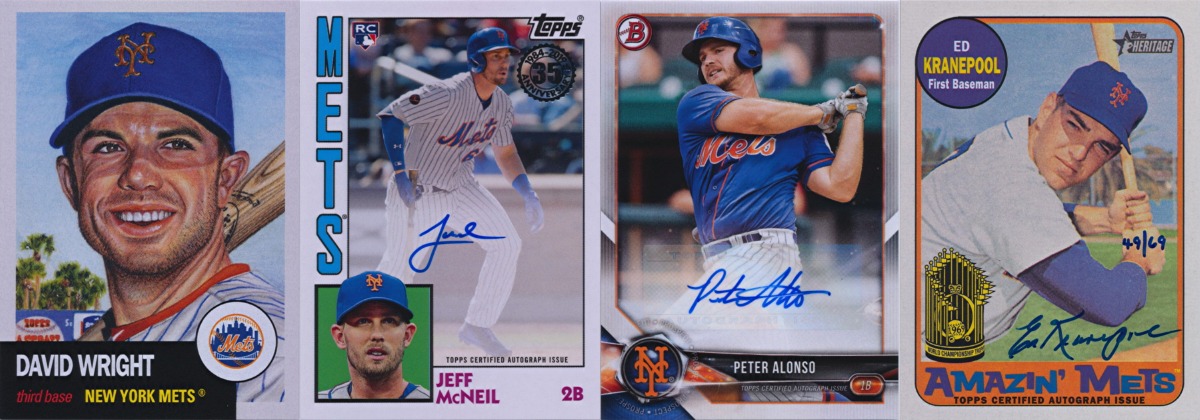
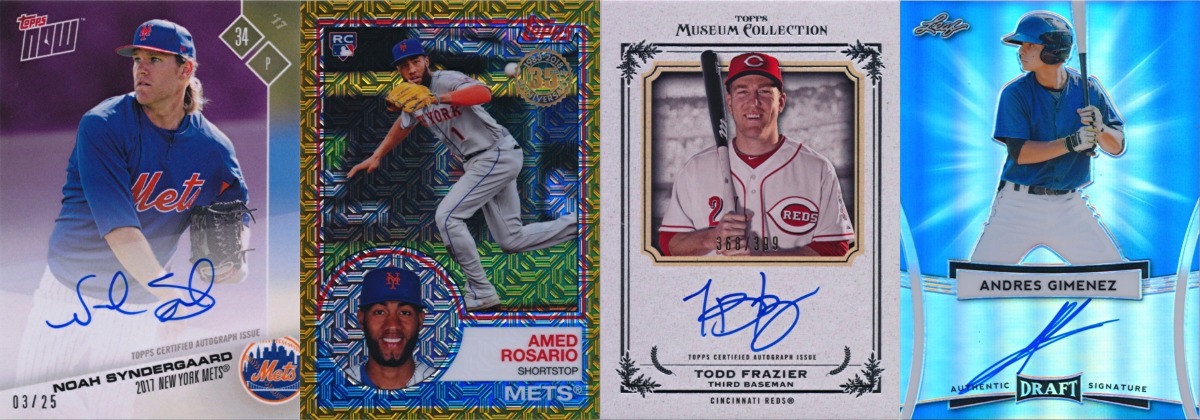
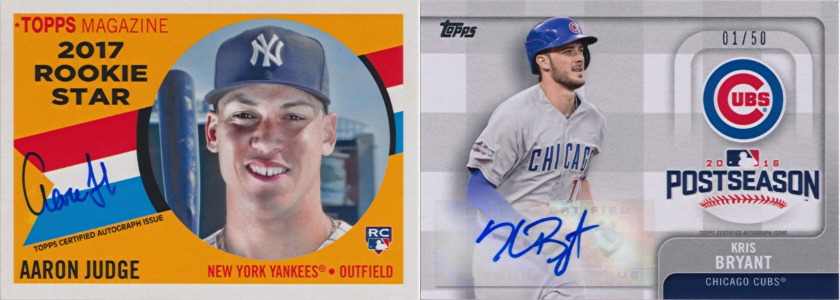
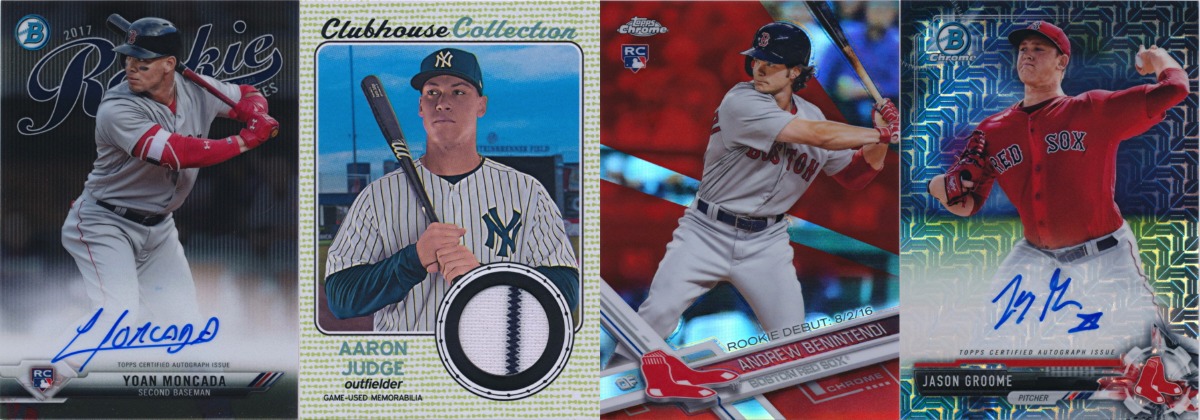
  • 30 game-used patch cards
  • One for each MLB franchise
  • All from Mets players
  • All patches match the team that the player is shown in
  • As many stars and Hall of Famers as I could manage
  • Enough players at each position to make a workable roster


Baseball card collecting: Hobby in crisis, Part 2

Baseball cards and traditional media, pot and kettle?

In Part 1, I looked at the factors that I saw playing a part in the success or failure of the baseball card industry. I wrote this without having seen the CBS News piece that has stirred up this discussion over at Beckett, Panini, Upper Deck, and Cardboard Connection. To me, the health of the hobby comes down to interest in the sport, innovation in the industry, and cost. Cost is the tricky one.

Today’s baseball card market looks nothing like it did 25 years ago. There are far more choices, a higher barrier to entry, a much wider spread between low-end and high-end, and a lot more baggage from years past. As I’ve lamented here, the small local card shows are largely a thing of the past. Even the regular mall shows are slowing down with eBay providing a much better option for buying and selling the kind of merchandise that pays the bills. Way back in 2000, I was at a mall show and saw a 2000 UD Legends Gary Carter Gold Autograph that would have been perfect for my then-fledgling Mets autograph collection. When I asked if the price was flexible, the dealer just asked if I was on eBay. Since I was, he said that we wouldn’t be able to make a deal. He just couldn’t compete with a global marketplace and wasn’t even going to try, instead opting to put his effort into selling to people who hadn’t yet gotten with the times. His market was dwindling and he knew it; it was just a matter of time before the old ways would no longer be viable.

The dealers I met during my third life as a card collector (2000-2003) were a much different breed from the ones back in the ’80s and ’90s. As with my local shop owner from the ’80s, these dealers had largely abandoned the storefront and now dealt in cards as a side business out of their homes, loading up their cars one weekend a month to set up a few tables in a mall and make deals with the ranks of the nostalgic and the faithful. They could cut you a deal on a complete 1978 Topps set or the Lenny Dykstra rookie that was inexplicably missing from your 1986 Topps set. They would gladly take any cards of local interest for trade or credit and would talk sports or cards with you when things slowed down. It was a support group for people trying to figure out how to cope with the changes in the hobby.

And that brings us to the CBS piece. The hobby is dying. A weekly local card show filled with ’70s Topps cards isn’t drawing in the kids. Cards are too expensive. Kids are only interested in video games and computers and girls. Times are tough for a celebrity card dealer who used to be rolling in cash. Give me a freaking break.

You know, we had video games, computers, and even girls (well, that one’s a bit of a stretch, for me at least) back in the ’80s. We didn’t have global networks and smartphones, but things haven’t changed that much on the “how kids spend their free time” front. The biggest change has been the social aspect – the Internet-connected game consoles and smartphones are bringing kids together like never before. Even the anime-inspired trading card games of the ’90s (and still going strong today) emphasize the social aspect of cards. What about baseball cards?

The appeal of baseball cards has been constantly changing since the mid ’80s. First popular for pictures of players and listings of stats, cards became seen as a viable investment as prices of older (and much scarcer) cards went through the roof. Baseball cards had gone from a novelty to a collectible, which can be a dangerous shift. When collectibles become self-aware, greed can bring about self-inflicted ruin. Overproduction made just about everything from this boom period worthless and created the unrealistic expectations that served as the point of comparison in the CBS report.

But who cares about what the market did ages ago? The rise of inserts and premium sets shifted the focus from sheer numbers to diversity. Upper Deck was premium from its start in 1989. Leaf went premium in 1990. Fleer and Topps launched premium lines in 1991. Bowman and Donruss went premium in 1992. Fleer, Topps, and Upper Deck launched super premium lines in 1993. Upper Deck went premium again in 1994. It was a never-ending escalation. Kids were priced out of the market.

The reality was that pack prices were always rising. The premium craze sped things up and undoubtedly pushed out the indifferent collector, but experiments in low-price alternatives like Triple Play and Collector’s Choice proved an important point – the market wanted a quality product. It wasn’t a market that catered exclusively to kids, and certainly the proportion of kids to adults had changed, but what could be done? Can you force a market to reduce profits just to match your nostalgic view of how things should be?

Maybe I just don’t get it because my nostalgia doesn’t fit the narrative. I knew very few card collectors when I was a kid and most of them were into higher-end products than I could afford. I was priced out of the market. And yet I still bought lots of cards until other obligations took over my time and attention, sampling most of the premium and super premium lines along the way (and now wishing that I had focused on quality over quantity). Have the demographics really changed all that much in 20 years?

And this is where I’m as lost as you are reading it. I’ve tried to touch on all of the factors that play into the success and failure of baseball cards. CBS showed how things are different now compared to an unrealistic bubble economy. I’ve painted a complex picture of an industry with many facets. CBS showed two very limited data points. I see uncertainty with signs pointing to at least modest success. CBS showed certain doom. I suppose I shouldn’t be surprised though, CBS produced a 5 minute fluff piece while I tried to capture the history of an industry and my connection to it. Reality often fails to fit into a convenient narrative.

Why even bother running a piece on an industry just to say “it’s doomed” and not even bother to back it up? Why not look at the tragic end of Upper Deck as a fixture in the hobby or Panini’s clumsy revival of the Playoff/Donruss brand? Why not point out the inherent irony in MLB Properties granting Topps a monopoly to encourage innovation? Of all the signs of the hobby’s impending demise they could have chosen, CBS went to the local interest well for a bunch of guys who are about as out of touch with the hobby as the reporters themselves. That’s the sign of an industry on the brink of failure.

I really don’t know what the future holds for the baseball card industry. And I don’t know if that future even matters to collectors, whatever it might hold. Collectors will continue no matter what happens in the industry, changing their focus to keep the hobby interesting, taking a break when they need to, and eventually coming back if and when they see a future in the hobby. I’ve been in and out of this hobby so many times that I barely recognize what I was in my previous incarnations. I look at cards that have no place in my collection now but were centerpieces once upon a time; I see others that mean far more to me now than they did years ago. Most of all though, I see this hobby’s past as being something that is rich for mining, with every new set adding to the diversity of a mosaic that is too great to be seen in whole. The totality of the hobby is not in the current month’s or year’s offering, it is in all of the products and collectors that have come before. The hobby is bigger than any one product, manufacturer, collector, or card show. The hobby is bigger than eBay, Beckett, or even the entire Internet. The hobby will live on long after cards stop being produced or games stop being played.

Now about that stack of 1975 Topps in the CBS piece, could someone check it against my wantlist? I really need to get working on that set…

Baseball card collecting: Hobby in crisis, Part 1

The hobby is dead; long live the hobby!

A recent CBS News report about the decline of baseball cards has, predictably, received a bit of criticism from the sports card industry. Beckett and Panini have weighed in, please start there to see where this controversy is coming from. Are the days of baseball cards numbered? Is this hobby dying a slow but certain death? Can the hobby survive without massive popularity among kids? Was this piece produced 15 years ago? The answers to all of these are a bit murky and require digging deep into the history of the hobby (well, the last one is a definite “it might as well have been”). In Part 1, I’ll take a stab at why the hobby could be in trouble. In Part 2, I’ll take a look at what CBS thinks and see where we can go from there.

There are two distinct points in time when I would have emphatically agreed that baseball cards could be headed for oblivion. The first was in late 2005, when Fleer went under and Donruss let the door hit its ass on its way out of the licensed baseball card business. Fleer’s demise was really not all that surprising (its reign as the longest-running non-Topps licensed baseball card manufacturer is the surprising part). The loss of Donruss, after five years of driving the industry to deliver more variety to collectors, was like the MLB Players Association giving fans the finger.

More than anything else, the move was made to ensure that cards were all about advertising the on-field product; the simplification of the product line, reduced emphasis on retired players, and MLBPA-mandated definition of Rookie Card (which now is the most meaningless designation in the sport, several rungs below Game Winning RBIs and ceremonial first-pitch throwers) all showed that the MLBPA was not happy with the baseball card industry catering to collectors and not impressionable children who could be counted on to buy lots of MLB-licensed merchandise if only baseball cards could be made simpler.

The second major blow was delivered by MLB Properties when they reinstated the Topps monopoly in 2009. While Topps wasn’t the only player in the baseball card market from 1956 to 1980, it did everything it could to keep competitors out of the market. In this time, about the only thing Topps didn’t try was innovation; the product in 1980 differed from the product of 20 years earlier mainly in photography. Card quality, design, and subject matter remained virtually unchanged for decades.

Things changed in 1981 when Fleer and Donruss finally entered the market with the intention of sticking around. For the rest of the decade, the three fought to get cards of the hottest new rookies into their products, making update sets standard (and creating the XRC confusion). Fleer and Donruss, forced to abandon gum after the court ruling that let them into the market was overturned, moved to slightly better card stock, with Score and then Upper Deck taking things further in 1988 and 1989, respectively. By the time Topps countered with a largely irrelevant late-season Bowman set, it was clear that change was necessary to keep up in the booming card market.

That’s what happens when you have competition. Sure, people complain about how it’s not like it was in the “old days,” but chances are that the real old days weren’t what they think they were. Things are always changing, whether it’s the price of a pack of cards, the number of cards in the pack, or the mix of cards from month-to-month (well, that stopped changing in 1974); the quality of the gum is the only true constant (kudos to Topps for getting the 2001 Heritage gum formulation so perfectly putrid). Monopolies slow the pace of change and put the industry at risk of irrelevance.

This is what makes the 2009 exclusive trading card deal between MLB Properties and Topps so troubling. Worse, when Upper Deck snubbed its nose at MLBP and produced a 2010 baseball card product with visible team names and logos, the resulting court battle ended in a settlement that all but guaranteed that Upper Deck would not be returning to the baseball card market; in addition to agreeing not to use MLB team names and logos, Upper Deck agreed not to use photos that had been altered to remove offending logos, leaving only artwork and non-baseball imagery as fair game should UD wish to produce an unlicensed set.

Things took a turn for the better in 2011 when Panini, the current owner of Donruss and Playoff (but not Leaf), secured a license from the MLB Players Association. While this is certainly a positive development, Panini has a long way to go to bring its cards up to the current industry standard (the lack of team logos and names and the continued release of 2011 products well into 2012 aren’t helping matters any either). Even Leaf (formerly Razor, not to be confused with the Donruss incarnation of Leaf) has managed to produce high-quality cards with no official licenses, so Panini’s initial efforts under their MLBPA license are disappointing to say the least.

So what does this say about the health of the hobby? Not a heck of a lot. You can talk financials (Upper Deck was near-ruin in the mid-90s and Topps was in the middle of several takeover/merger attempts in 2007), but that’s too far removed from the average collector to be relatable. The booms of the mid-to-late-80s and early-to-mid-00s can teach us a few lessons. Mainly, interest in the sport is a big factor in the success of baseball cards; unlike what the MLBPA would like to believe, the sport is an advertisement for the hobby, not the other way around. The strikes in 1981 and 1994 corresponded to down years for the baseball card industry, while renewed interest in the sport in the following years corresponds to the previously mentioned booms. Today, we’re coming off another downturn caused by the revelation of the Steroid Era and should be looking at an upswing in the near future (particularly if perennial losers Royals and Pirates and big-market busts Mets and Dodgers can get competitive again). This should result in a stronger baseball card market, all things being equal, but are they?

Check back tomorrow for Part 2: Baseball cards and traditional media, pot and kettle?

Upper Deck: A Love Story (Part 1)

How four packs of cards changed my world

What follows is the first part in an overly long missive documenting my 20+ year on-again/off-again relationship as a customer of a corporate entity that produces precisely-cut pieces of cardboard.  As with any love story, there are ups and downs, blind devotion, shattered dreams, renewed passion, false hope, and a tragic ending that Dickens would have to rewrite to appeal to his simple-minded readers.  I am no Dickens and I have no readers, so this story will be told as it happened, with no punches pulled.

Looking back, it’s hard to remember those feelings from so long ago.  Back in those days, the idea of a world without them was beyond my imagination.  The sheer joy of finding something new and exciting, the realization that this was something to be cherished…  It’s been about two years now.  Two years since we lost Upper Deck as a licensed baseball card manufacturer.

Read more »