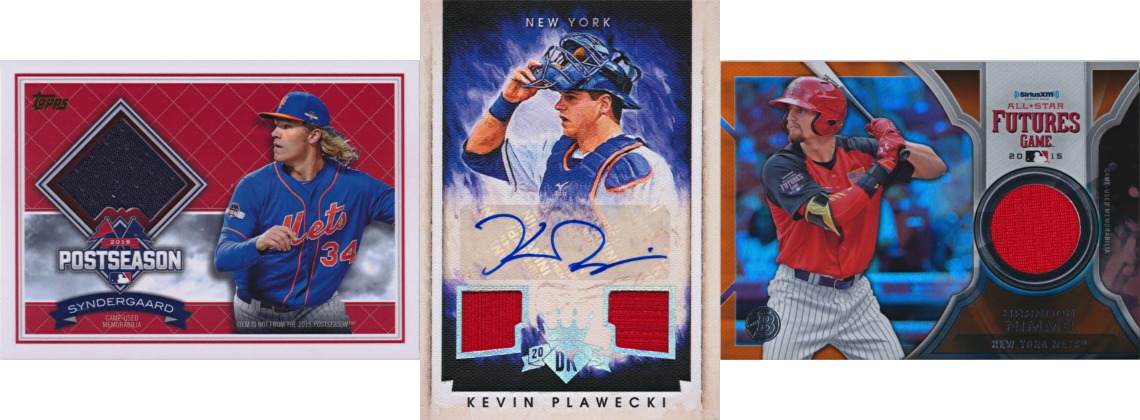
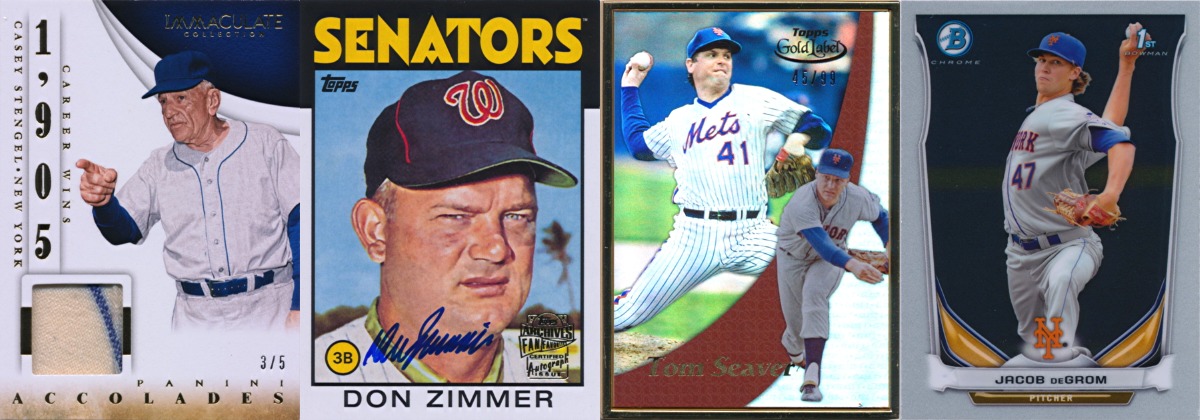
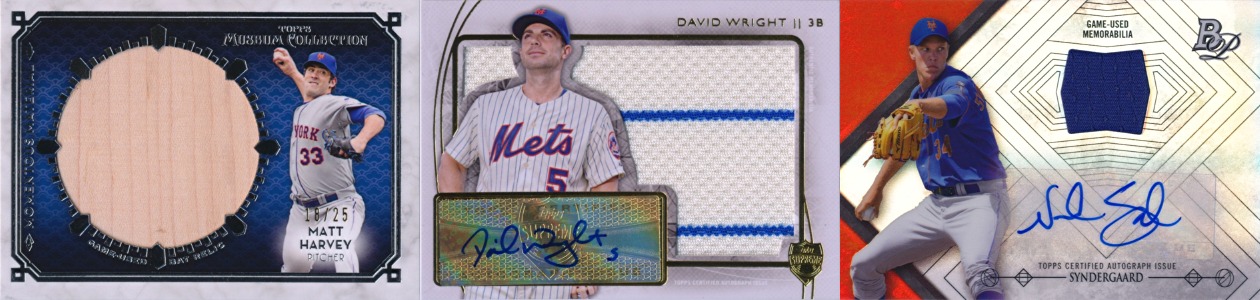
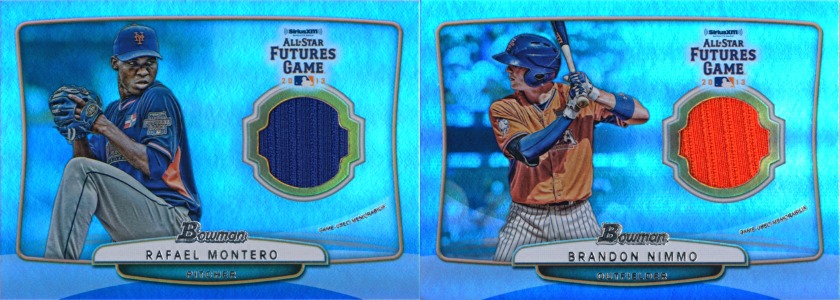
Category Archives: Game-Used

Five Must-Have Mets Cards

Cornerstones of any Mets collection

You know, I’m not doing enough fluff pieces on here.  While I continue to scan cards for some more significant pieces, here’s a quick look at a few nice Mets cards.  If you want to berate me for not including any cards from Tom Seaver, Gary Carter, David Wright, or Victor Zambrano, feel free to leave a comment with your suggestions.  Maybe I’ll even throw another of these together to fill space sometime.

1997 Upper Deck Game Jersey Rey Ordonez GJ3

There are few more significant jersey cards in baseball card history than Ordonez’s 1997 Game Jersey insert.  Actually, there are two, number GJ1 and number GJ2 from this set.  Ordonez is the odd man out in the debut jersey card set behind Ken Griffey Jr. and Tony Gwynn.  Still, this is the first piece of Mets jersey issued in a baseball card and helped to usher in a new era of collecting.

2000 Upper Deck Game Jersey Patch Mike Piazza P-MP

While Rey Ordonez has the distinction of having the first Mets jersey card, Mike Piazza became the first Met with a patch card in 2000 (let’s not talk about 1998 and 1999, at least not until I finish the next Mets Game-Used History segment).  Nearly impossible to pull at the time, this card still commands a decent price despite the multitude of Piazza patch cards on the market.  There’s only one first and this one is it.  Piazza has gone on to have countless patch cards released and more than 60 other Mets players have joined him.

2001 Upper Deck Signed Game Jersey Nolan Ryan Mets H-NRm

Nolan Ryan may be one of the biggest stars to come up through the Mets system, but he didn’t really do much as a Met. That doesn’t stop the card companies from celebrating Ryan’s time on the team though. Pieces of one of Ryan’s Mets jerseys (flannel pinstripes) began showing up in cards as early as 2000, typically depicting him in a Rangers uniform. Upper Deck gave all of Ryan’s teams their proper respect in 2001′s Game Jersey inserts. Between the base jersey, signed jersey, and dual jersey inserts, Ryan was featured in every uniform with pieces from the appropriate jersey. This Mets version includes a large (by today’s standards) swatch of pinstriped jersey with an on-card autograph. Short of an autographed Mets patch card (see 2011 Topps), this is about as good as it gets for Ryan memorabilia.

2010 Upper Deck A Piece of History 500 Club Gary Sheffield 500HR-GS

Gary Sheffield became the first player to hit his 500th home run as a Met in 2009 and Upper Deck commemorated it in 2010 with the final entry (so far) in the A Piece of History 500 Club bat card insert set. As with the other cards in this product, the card features barely cropped and/or obscured logos, which Upper Deck was not allowed to use. The product may have doomed Upper Deck, but this card remains a key piece of Mets history.

2011 Topps Marquee Titanic Threads Jumbo Relics Carlos Beltran TTJR-69

Released after Beltran had been traded to the Giants, this card might seem a bit out of place.  Its significance however cannot be overstated.  The included jersey swatch, big enough to feature three pinstripes on some versions, isn’t notable just because Carlos Beltran wore it.  The Beltran jersey cards in this product are in fact the only cards to feature a piece of Mets pinstripe jersey worn between about 2009 and 2011.  All others are either from before the recessed mesh style Cool Base jerseys were adopted or after the Cool Base formula changed to a more standard weave for the 2012 season.

Best Mets Cards of 2012

Looking back at things that didn’t suck about the Mets in 2012

Well, the Mets didn’t win the World Series last year.  Or make the playoffs.  Or finish with a winning record.  They didn’t finish in last place, but that’s more because of the Marlins than anything the Mets did.  The year started off with the Mets in contention, but the second half crash and burn was in full effect in 2012.  What a miserable year.

Except for a few bright spots.  After just over 50 years, the Mets got their first no-hitter, courtesy of Johan Santana and a questionable foul ball call on Carlos Beltran.  After more than 20 years, the Mets had a 20-game winner in R.A. Dickey, who then went on to become the first knuckleball pitcher to win the Cy Young Award (before being traded to the Blue Jays).  Matt Harvey made an impressive debut and Zack Wheeler worked his way up to be in position to do the same in 2013.  And of course David Wright was back in MVP form and signed a contract that should keep him in a Mets uniform until the end of his playing days.

In the errata category, the Mets brought back Banner Day and will have it back again this year.  They also finally announced that Citi Field will host the 2013 All-Star game.  And that pesky black drop shadow has finally been banished from the uniforms.  The black uniforms themselves refuse to die, but a pair of new blue alternates should keep their use to a minimum.  And how about those $20 clearance blue Dickey jerseys that everyone except me was able to get?  I am still accepting Christmas presents if anyone has an extra road version in XL.

As for baseball cards, 2012 had a few bright spots.  While Mets representation in some products (Topps Heritage) was very poor, there was still a good supply of new game-used and autograph cards, plus plenty of official Rookie Cards and actual first cards.  Here’s a few of the best (and worst) cards that 2012 had to offer.

Best Manufactured Material

2012 Topps Series 1 Golden Greats Coin Tom Seaver

Topps had some interesting manufactured material inserts this year, but none could come close to their coin relic cards.  These huge double-sided medallions are absolutely stunning in person.  Topps Update introduced the runner-up, the Hall of Fame Plaque manufactured material relic.  It’s hard to beat a heavy chunk of metal.

Best Parallel Insert Set

2012 Topps Archives Gold Foil Parallel

Topps introduced even more types of parallel cards this year with the various colors of Ice and Wave Refractor parallels in addition to the usual colored borders, sparkles, refractors, xfractors, atomic refractors, superfractors, etc.  None of them were even close to being a match for the gold foil parallels in Topps Archives.  These look great in person and get even better when scanned (unlike most chrome/refractor cards).

Best Sticker Autograph

2012 Topps Archives Fan Favorites Autograph Gary Carter

Sure, he’s not shown as a Met, but there isn’t a Mets sticker autograph that can come close to this.  Not only is this an autograph from the late Gary Carter on a 1975-style card, but this is the first-ever sticker autograph to appear in a Topps Archives product.

Best On-Card Autograph

2012 Topps Five Star Silver Ink Gold Signature R.A. Dickey

Alternatives to the usual blue (and occasional black or red) autographs have been in short supply in recent years, but Topps released some nice specimens in silver, gold, and white marker in several of its premium products.  The best of the bunch has to be R.A. Dickey’s gold signature in Topps Five Star.  Between the strokes of the signature and the picture chosen to accompany it, there’s really nothing more you could want from this card (well, other than less chipping).  The card itself has three color variants (all numbered to 10 or 5), but I like the look of the purple version.

One problem with the silver and gold markers Topps used this year is that they don’t always write evenly, leaving many signatures looking weak and washed out.  That wasn’t a problem for the white ink parallels in Topps Tier One though.  Combine the strength of the ink with David Wright’s signature and you have a clear winner (or runner-up in this case).  These were released as redemptions (boo!), but they were fulfilled fairly quickly (woo!).

Worst Autograph

2012 Panini Signature Series MLBPA Logo Autograph Jordany Valdespin

This card had a lot going against it before it even got to the autograph.  First, without a license from MLB Properties, Panini couldn’t use proper team names or logos, instead settling for “New York Baseball Club” in place of Mets and cropping out all logos.  Next, their style of patch isn’t terribly exciting, essentially being just some embroidery on the fabric.  And the use of the MLBPA logo, while something to brag about because it is the one license they do have, just isn’t all that interesting (and the detail doesn’t really come through all that well).  Add in the two other manufactured material autograph sets with the same checklist (one with the iconic Rated Rookie logo and one on simulated baseballs), and this card looks like a dud.

Add in the autograph and it’s a total bomb.  J-stroke, dot, V-stroke, dot.  Look, I know these kids have a lot of autographs to sign, and nobody writes anything by hand anymore, but has it really come to this?  That’s not an autograph, those are initials.  I’m not expecting calligraphy or anything, but is it too much to ask for these guys to at least come up with a symbol they can draw?  I’ll even take a random scribble over something like this.  The autograph market is in trouble if the future holds nothing but simple initials.

Best Uniform Memorabilia Card

2012 Topps Triple Threads Unity Autographed Relic R.A. Dickey

Did you even need to ask?  They may not be big, but Dickey’s pants swatches are the only Mets pinstripe material from an active Mets player in 2012 and are the first Mets pinstripes from the last three seasons’ uniforms.  And he also threw a one-hitter wearing them.  There’s just no way to top that.

Best Patch Card

2012 Topps Update All-Star Jumbo Patch R.A. Dickey

A mockup of what this card sort of looks like

Dickey’s jumbo All-Star Patches are a thing of beauty, but being numbered to 6 has kept them from my hands (and scanner).  I’ve got the whole (non-Dickey-worn) jersey in my closet though, so I can make do without it.

Best Bat Card

2012 Topps Museum Collection Dual Jumbo Lumber Ike Davis David Wright

Bat cards aren’t that big of a draw anymore and in most cases are just variants of generic relic cards that may contain a piece of bat or jersey.  Museum Collection offered one of the only bat-only memorabilia inserts in its Jumbo Lumber relics.  Not only were these limited to bats specifically, but every piece was nice and big.  The dual version paired David Wright, the Mets’ lone representative in the single Jumbo Lumber relics, with Ike Davis.  For Ike, this was his first memorabilia card of the year.

Best Other Memorabilia Card

2011 Panini Limited Hard Hats Dwight Gooden

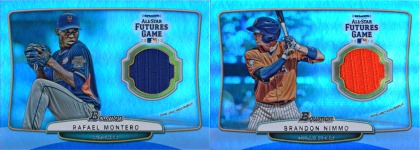
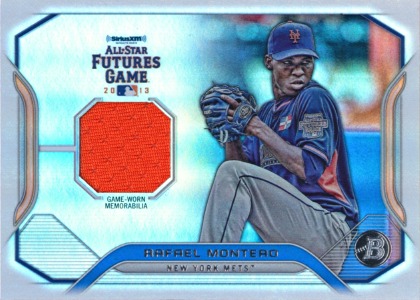
Panini was still stuck in 2011 in May of 2012 when they released Panini Limited, a product filled with interesting memorabilia cards like what Playoff/Donruss was known for.  Dwight Gooden was well-represented with bat, jersey, hat, and fielding glove pieces in addition to the (no pun intended) crown jewel: a piece of game-used helmet.  Helmet cards are extremely rare, somewhere between wristbands and catcher’s equipment.  This is the first MLB-worn helmet card from a Mets player (previous examples are all from the 2000 Futures Game) and may have been from a Mets helmet.  No pieces of the Helmet’s logo have surfaced, so we may never know for sure.

Worst Memorabilia Card

2012 Topps Triple Threads Relic Jose Reyes “Fresh Fish”

Really, Topps?  These lame attempts to be hip and quirky are why I can’t get behind Triple Threads as a product.  What’s next, referring to David Wright and his impending contract extension as “D-Money?”  Oh, right.  These stupid phrases are almost as idiotic as eBay sellers who think there are more than three pieces of memorabilia in them because of the windowing (hint: it’s called “Triple” Threads for a reason).

Autograph Product of the Year

2012 Topps Archives

The return of Topps Archives was one of the biggest card-related stories of the year and the product did not disappoint.  Picking up where the 2005 product left off, 2012 Archives was loaded with autographs from big stars and minor favorites alike, packing in autographs from 20 former Mets (Nolan Ryan and Willie Mays are not shown, for obvious reasons), all on-card except for Carter (for obvious reasons).

Honorable Mention – 2011 Donruss Elite Extra Edition

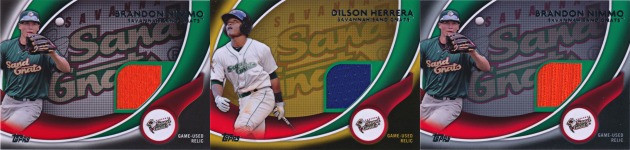
Yeah, Panini has a different kind of calendar.  This was one of the first new Panini baseball products and it got plenty of attention.  While Topps put autographs from the Mets’ top two 2011 draft picks in 2011 Bowman Draft Picks and Prospects and moved on, Panini went with the top four, plus Phillip Evans.  Then they threw in Chris Schwinden for good measure.  Most of the autographs are on stickers (some of the Nimmos and Fulmers are the only ones that are on-card), but the unique player selection, die-cut parallels, and interesting ink variants more than make up for that.  Topps has shown no interest in autographs from “lesser” draft picks, so this would be a good niche for Panini to focus on.

Game-Used Product of the Year

2012 Topps Museum Collection

Great card design, lots of material variety, decent player selection.  I could go on, but what more is there to say?

Honorable Mention: 2012 Topps Triple Threads

I may not personally like the style and format of Triple Threads, but you can’t ignore the material.  So many players and so much new material are in this product that it always rates as one of the most significant products of the year.  But I’m still not giving it the top spot.

2012 Mets Baseball Card Year in Review

At long last, I have Dickey pants

If you were looking for Mets pinstripe jersey cards this year, your only options for the bulk of the season were pieces from Gary Carter and Dwight Gooden.  In fact, the last few years have been pretty barren for Mets pinstripes from active players, with just Carlos Beltran in 2011 and Johan Santana in 2010.  No pieces from the pinstripe jerseys worn in 2010 (cream) or 2011 (ivory) have been released in cards.  On that second point, nothing changed in 2012.  The good news is that R.A. Dickey is here to save the hobby.

Not content to merely conquer mountains, books, movies, and that whole pitching thing, Dickey provided Topps with the material to produce the first pinstriped memorabilia card of an active Mets player since Santana in 2010.  And this wasn’t just any old memorabilia, it was his pants from his second consecutive no-hitter, complete with distinctive dirt stains.  On top of that, he also signed a couple thousand autograph stickers to be put on these and future cards.  This is why everyone loves Dickey.

The Mets Have the Blues

Perhaps the biggest news in Port St. Lucie this spring wasn’t related to the players but instead what they were wearing.  The Mets had tried to get an alternate blue jersey added for 2012 but failed to get the design approved in time.  As a consolation, MLB waived its usual requirement that all batting practice jerseys must be some sort of two-tone abomination and let the Mets use an all-blue version of the new style batting practice jersey (first seen at the 2011 All-Star event).  Jordany Valdespin became the first Met to have one of these jerseys released one piece at a time in Topps Finest.

While Valdespin was alone with this year’s batting practice jersey, several other players had pieces of blue recessed mesh material from previous years’ batting practice jerseys or Los Mets jerseys released in 2012 products.  Jose Reyes and Dillon Gee made their blue debuts in Topps Museum Collection, Angel Pagan debuted in Topps Allen & Ginter’s, and Ruben Tejada and Josh Thole rounded out the group in Topps Triple Threads.

And the Black Came Back

2012 was a landmark year in black removal for the Mets with the banishment of drop shadows, hybrid blue/black hats, and black socks and undershirts.  One area they fell short in though was the elimination of the black alternate jersey.  This jersey made one appearance in 2012 as part of a tribute to John Franco, whose Mets tenure, it should be pointed out, long predates the sad day when someone thought that black would good on the Mets.  The black uniform just won’t die though (it has been confirmed to be in the mix for 2013) and Kirk Nieuwenhuis made his jersey debut with pieces from a black jersey which, if Topps is being honest, must be from the Franco game.  I feel the urge to burn these cards, but I’m not ready to part with some of the dozens of Nieuwenhuis autograph cards I got this year.  Tip for Kirk: learn to sign with your right hand.  At this rate, Topps will burn you out before the Mets get a chance to.

And a Touch of Gray

While this year’s gray road jerseys looked sharp, I doubt the pieces embedded in cards will be any more exciting than the usual boring gray swatches we’ve been seeing for years.  Like the blue and black before them, three players appeared in Mets gray for the first time: Ruben Tejada, Lucas Duda, and Daniel Murphy.  Duda’s was his first-ever game-used, Murphy’s was his first-ever jersey (likely pants though), and Tejada’s was, along with his blue jerseys, his first MLB-worn material (his previous game-used pieces are from a WBC jersey), though I only ever saw one card with a gray swatch (possible Topps mix-up?).

Patches

Rounding out this year’s game-used newcomers (nobody had their first bat cards this year) are Jordany Valdespin, Kirk Nieuwenhuis, Ruben Tejada, and Lucas Duda with their first Mets patch cards and Daniel Murphy with his first piping cards.

Back in April, I picked Ruben Tejada, R.A. Dickey, Lucas Duda, Chris Schwinden, Bobby Parnell, Mike Baxter, and Daniel Murphy to get some new memorabilia cards this year.  Tejada (jersey/patch), Dickey (pants), Duda (jersey/patch), and Murphy (jersey/piping) all delivered, Parnell and Baxter could be in the mix for next year, and Schwinden is probably off the radar after his waiver claim whirlwind tour of AAA that ended back where it began.  Kirk Nieuwenhuis and Jordany Valdespin exceeded expectations with jersey and patch cards released in their rookie years.  I have to give Topps credit, they turned out material from these guys much faster than I thought they would.

Stars Past, Present, and Future

The All-Star event is always a good source of new memorabilia and this year’s didn’t disappoint.  David Wright and R.A. Dickey were the only Mets on the NL All-Star team, with Beltran joining them as an ex-Met.  For the second year in a row, no former or (as of yet) future Mets were on the AL All-Star team.  Unlike last year, secondary colors were not mixed in with the primary color swatches (except in a couple of three-player cards), so we only got three blue jersey cards.  And a few outstanding jumbo patches.  With “few” meaning 6 of each player.  Sadly, this put them out of my price range (the authentic jerseys cost far less and have all of the patches, though not event-worn).  I miss the days of All-Star patch cards numbered to 100…

Over in Futures land, the Mets sent a pair of players to make their second appearance at the event.  Wilmer Flores (2009 World Team) and Zack Wheeler (2010 USA Team) went back for a second time as their days in the minors wind down.  Patch cards here were somewhat more plentiful, though Wheeler’s haven’t hit the secondary market in quantity yet (I’ve only seen two put up for sale out of the 35 total made).  As with the All-Star jersey cards, secondary colors have yet to appear.

Well, for the 2012 Futures Game at least.  2012 Topps Pro Debut featured cards with primary and secondary color swatches from 2011 Futures Game jerseys (Matt Harvey and Jefry Marte).  A few patch cards also appeared in a couple of products.  2011 All-Star jersey patch cards from David Wright, Jose Reyes, and Carlos Beltran were released in 2012 Topps Series 1 and 2012 Topps Triple Threads, though all were numbered to 9 or 1.

Elsewhere in MLB

Carlos Beltran and Jose Reyes suited up with new teams this year and both had new memorabilia from their post-Mets days released in 2012.  Beltran started the year with jumbo jersey cards from a Giants uniform in Topps Museum Collection and finished it with jersey and patch pieces from a Cardinals jersey in Topps Triple Threads.  Reyes’s Marlins spring training jersey made its way into Topps Triple Threads with black, black mesh, and orange mesh jersey pieces and a few patch cards.

Oh, and there was a massive scandal involving the sale of fake game-used memorabilia to all three major card manufacturers.  The manufacturers have been silent on this issue.

Heavy Metal

Let’s face it, game-used material in baseball cards is getting boring.  Other sports have things like lacing or material other than fabric and wood, but the best MLB can do is patches, tags, bat knobs, and bat name plates.  It doesn’t help that most of the jerseys in MLB are white, gray, or black; say what you will about Oakland’s yellow jerseys, but they’re certainly not boring.

With game-used material failing to excite the masses, Topps has turned to manufactured material to add some variety to its relic offerings.  Past offerings have brought us patches, hat logos, and poorly-received glove leather, but Topps went in a different direction in 2012.  This year, Topps introduced four types of metal manufactured material cards, all in its mainline product.  The pins and rings are missing the parts that would make them pins and rings (pointy bits and, um, rings, respectively), but the coins are complete double-sided medallions.  The Hall of Fame plaques turned out to be some of the best metal cards produced, even though they don’t look much like the actual plaques.  Tom Seaver is the Mets’ lone representative in most of these sets, with a Darryl Strawberry pin card being the only exception.

Topps brought logo patches to the minors in this year’s Pro Debut and Heritage Minor League.  The Mets had representatives from their four highest-level minor league teams, though the two from Heritage Minor League came as redemptions that didn’t get sent out until late December.  I guess it’s better than that 2011 Bowman Platinum Matt Harvey Autograph I’m still waiting for…

Speaking of autographs, Panini isn’t going to be left out of this.  2012 Panini Signature included three different manufactured material autographs from three Mets.  It’s not quite Sweet Spot, but it’s a promising start.

Partying Like It’s 1969

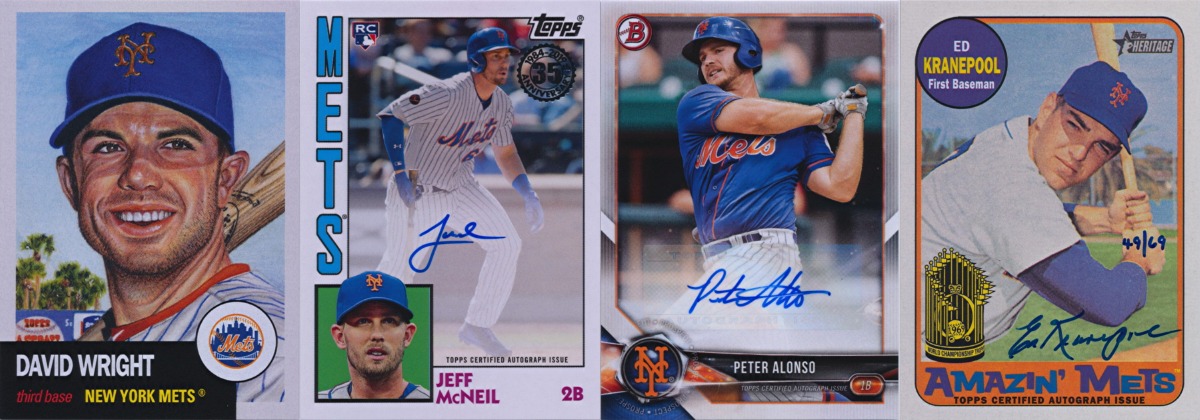
The return of Topps Archives was one of the high points of 2012 and it came with an outstanding autograph set.  In fact, a set of retired player on-card autographs like this hasn’t been seen since Archives last appeared in 2005.  While the 2012 product can’t rival 2005′s list of Mets, it still featured seven Mets and several more former Mets shown in other uniforms (most notably Jose Oquendo on nine different cards, one for each position he played in a single game).  Among those are 1969 Mets Bud Harrelson, Cleon Jones, and Ed Kranepool, back after an absence of several years.  Kranepool later appeared on more on-card autograph cards in Topps Tier One and sticker autograph cards in Topps Update.

Justin Turner Auto Time

Also appearing on a sticker autograph in Topps Update is Justin Turner.  Turner, best known for being the guy who pies people after walkoff wins, received his first game-used jersey card at the very end of 2011 in Bowman Sterling.  He follows that up in 2012 with his first certified autograph card.

Inked

Several other Mets had certified autograph cards for the first time in 2012.  Chris Schwinden started things off in 2011 Panini Donruss Elite Extra Edition alongside several 2011 draft picks.  Jordany Valdespin became the first Met with a 2012 Bowman autograph with a sticker autograph in Bowman retail packs (sadly, no Mets were featured in the chrome on-card autographs in Bowman and Bowman Chrome).  2012 draft picks Gavin Cecchini and Kevin Plawecki rounded out the meager Mets offerings in Bowman with chrome autographs in Bowman Draft Picks & Prospects and Bowman Sterling.

Topps Heritage, as usual, added autographs from several Mets from the 1960s: Craig Anderson, Chico Fernandez, Ed Bauta, and Hobie Landrith.

Topps Breaks the Ice with a New Wave of Refractors

I am so sorry for that.  With such a limited selection of parallels between the various colored borders, colored border refractors, atomic refractors, xfractors, and superfractors, Topps was in dire need of something new.  Enter the ice parallels (base Bowman) and wave refractors (Bowman Chrome), both with serial numbered color variants of their own.  Topps leads the way in making the same card as many times as possible.

Bonus!

Everybody loves free packs, so I was glad to see that all three major manufacturers found ways to deliver added value through extra packs (though only two of them featured baseball cards).

Upper Deck had the only true “free” offering with its National Hockey Card Day packs, now available south of the (Canadian) border.  It seems like not many people knew about it in the US, because I was the first person to ask about it in one shop and the second shop gave me four packs because of the amount they had left at the end of the day.  With a 15-card set, 5 5-card packs should have been enough to get close to completing the set.  If not for another colossal Upper Deck collation screw-up.  The 5 packs only had 8 different cards, with the same two cards on the top in each pack.  Upper Deck has acknowledged the problem and claims that it will be corrected when they bring the promotion back in 2013, which may happen before the 2012-2013 NHL season starts.

Panini continues to endear itself to collectors through frequent promotional giveaways, though none of them applied to baseball until their Black Friday promotion, which featured players from all four sports.  With a free pack of two Black Friday cards for every $10 spent on boxes of Panini products, it didn’t take much to get quite a haul.  The packs featured the biggest rookies and stars in each sport and mixed in cracked ice parallels, autographs, and memorabilia cards.  It was hard not to like what came out of these packs, even if you don’t follow the other sports.  I traded away my biggest pull, an Anthony Davis serial numbered rookie card, for a couple of Mike Trout rookies; my packs had no baseball cards but were loaded with basketball, so I traded with a basketball collector who opened his packs in the shop at the same time.  I can’t wait to see what Panini has in store for 2013, they made collecting fun again in 2012.

And then there’s Topps.  Topps had various promotions in 2012, but no real giveaways; everything was an exchange, either in-store card exchanges or wrapper redemptions.  Four products featured mail-in wrapper redemptions: Topps Series 1, Topps Series 2, Bowman, and Bowman Chrome.  For the Topps line, the redemptions were for packs of Gold Rush cards, which also included autographed (sticker) versions numbered to 100.  For Bowman, the redemptions were for packs of blue wave refractors, with autographed versions numbered to 50 and red wave parallels numbered to 50.  I skipped Topps Series 1 but sent in for the others, with mixed results.  The Topps Series 2 Gold Rush packs were a total bust, with only 6 different cards between two 5-card packs (the duplicates were even in the same order, indicating a fixed pack-out sequence and an offset of just one position between the two packs).  Bowman was the big winner, with four boxes bringing back four 5-card packs loaded with prospects, with one red wave refractor and one autograph.  Bowman Chrome had half the return with four boxes only bringing back two packs with a low value autograph being the only big card.  Overall, that’s a pretty good bonus, but I could do without the Gold Rush packs (should have just sold the packs…).

Farewells

Now the hard part.  Several Mets have turned in their pinstripes in 2012, though I expect it will take a few months for the cards to catch up.

After suffering a season-ending injury at the start of the 2012 season, Mike Pelfrey was non-tendered and signed with the Twins in the offseason.  Pelfrey hasn’t been relevant in cards for several years, but he was still a reliable starter and will be missed.

The same can’t be said for Jason Bay, who was released on a largely deferred buyout after his third disappointing season with the Mets.  He didn’t have any premium cards in 2012, but he was still inexplicably featured as a short print in Topps Heritage and one of only three Mets in the Topps Opening Day set.  He signed with the Mariners and we wish him the best.

With Bay gone, the Mets had an opening for a right-handed outfielder.  Their solution?  Trade Jefry Marte for Collin Cowgill.  Marte last played at the AA level as a third baseman, so he was expendable.  He signed a ball for me at a Binghamton Mets game, so I’m a little bit sad to see him go.

The Mets have been sorely lacking in offensive production at the catcher position, so changes needed to be made.  A late-season deal sent Rule 5 pickup Pedro Beato to the Red Sox for Kelly Shoppach.  Shoppach himself was then let go in free agency.  Mike Nickeas was lost and reacquired as a minor league free agent before being traded with Josh Thole to the Blue Jays for catchers John Buck and Travis d’Arnaud (among others).  Thole outperformed expectations with the Mets but lost all of his power after a collision at the plate left him with a concussion.  Mike Nickeas didn’t fare any better at the major league level but excelled in AAA.  You hate to see guys like this leave, but changes needed to be made.

Oh, right, the centerpiece of the above trade was none other than Mets ace and Cy Young knuckleballer R.A. Dickey.  Dickey started 2012 a fan favorite and ended it a folk hero, outshining Tim Tebow and Jeremy Lin.  Unfortunately, his stellar performance and reasonable contract made him a prime trade chip, especially when the available pitching dried up and the Blue Jays needed an ace to have a chance at the suddenly wide-open AL East.  With the best catching prospect in baseball and an overpaid Marlins castoff among their ranks, they had what it took to make a Dickey deal inevitable.  And they also threw in a top pitching prospect and a young promising outfielder.  Losing Dickey is tough, but you can’t not make that deal.  Or at least that’s what I keep telling myself.  I won’t be upset if Topps takes a few months to update Dickey’s team affiliation.

A few other faces from 2012 won’t be back in 2013, though it might take a while for the offseason to shake things out.  Andres Torres has moved on and Kelly Shoppach probably won’t be back.  Update: Looks like I left Omar Quintanilla out, but he’s now back with the Mets so that one’s moot.  I also forgot about Miguel Batista, but we all forgot about Miguel Batista (or at least we try to).

Hails

After losing 88 games, the Mets needed to make some serious changes.  As of the end of 2012 though, they’re really no better off going into 2013 than they were a year earlier.  Beyond that though, the farm system is looking better, so that’s something.  It’s going to be a long 2013.

Travis d’Arnaud was the centerpiece of the Toronto side of the Dickey trade, but his card history is nothing special, just a jersey card in 2011 Topps Heritage Minor League Edition and some autographs.  He was selected to appear in the 2012 Futures Game but did not attend due to injury, so there’s no memorabilia from that.

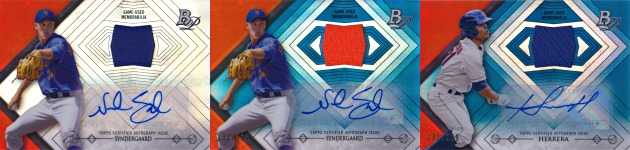
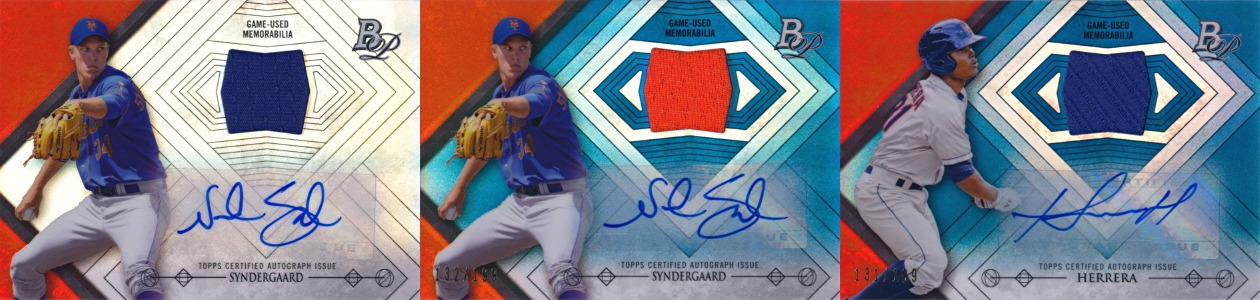
Noah Syndergaard adds yet another interesting pitcher to a single A level that is loaded with pitching.  Even though he’s still a few years out, he already has a couple of autograph cards.

John Buck was the big haul in the Dickey trade, from a card perspective at least.  Despite not having a superstar pedigree, he hits on pretty much every type of memorabilia: autograph, Futures Game (2002 USA Team), All-Star (2010 AL), colored jersey (blue Royals), pinstripe jersey (Astros), patch (Astros), bat, fielding glove, catcher’s equipment, etc.  Interestingly, much of his memorabilia is from the Astros even though he never appeared in an official Astros game (spring training?).  At a total value of 7.25 GU, Buck rates as the best acquisition since Gary Sheffield, who came in at more than double Buck’s mark.

Needing a big righty bat in the outfield, the Mets dealt surplus third base prospect Jefry Marte to Oakland for outfielder Collin Cowgill.  Don’t everyone get excited at once.  It’s an upgrade, but the outfield looked terrible beforehand.  Sadly, I pulled one of his autographs from 2012 Topps Chrome and sold it on eBay for $0.99.  Crap.  I really need to hang on to more of these worthless autographs.

In Memorium

Several former Mets passed on in 2012, but one has been a major fixture in the hobby for many years.  As I covered previously, Gary Carter has been one of the most prominent Mets in game-used and autograph cards since 1999.  He will undoubtedly be remembered in cards for many years to come.

Curse of the Pinstripes

Was R.A. Dickey’s departure foretold in cardboard?

One of R.A. Dickey’s final Dickeyfaces as a Met at Citi Field

R.A. Dickey’s career has been quite the roller coaster ride so far, hasn’t it?  A lot of us have been along for the ride for the last three years, but the latest development has us in free fall.  Like half of the Marlins just a few weeks ago, Dickey is headed north to the Blue Jays.  In return, the Mets get a legitimate catching prospect, something the organization has been in dire need of for a while.  Josh Thole has done an admirable job, but the team needs to get better and this is a step toward doing that.  Dickey may no longer be a Met (once the deal becomes official anyway), but he has meant a lot to an organization that hasn’t had much to cheer for lately.  I’m glad to have been able to see him pitch at Citi Field in what turned out to be his last game there as a Met.  No matter what he does in Toronto, he’ll always have a special place with the Mets.

How did it come to this?  Why would the Mets, after doing almost nothing to improve the team in the offseason, trade away their best pitcher, a 20 game winner and Cy Young Award recipient?  Have things really gotten so bad that a New York team has to wring every last penny of value out of its assets just to remain viable?  Starting pitching is one of the team’s strengths, but depth is still a concern.  Will Santana be able to hold down a spot in the rotation for the whole season?  Will Wheeler be ready?  Can Mejia, Hefner, McHugh, or whoever else gets called on to fill in be effective enough?  In a twist of irony, Omar Minaya, the very man who signed Dickey, is also the one most responsible for depleting the farm system to the point that it was necessary to trade him for prospects.  Yet another Minaya victory has been negated by his failures.

But what about the crackpot conspiracy theories?  What completely unrelated event could have somehow prevented Dickey from putting on a Mets uniform in 2013?  He wasn’t on any video game boxes, so what could it be?  Well, you’ve come to the right place, because I’ve got the answer you won’t find anywhere else.  Dickey’s pinstripe game-used memorabilia cards in 2012 ensured that he would not appear in a game as a Met in 2013.

Dickey’s pants from his second one-hitter of 2012 sure seemed lucky when Topps got a hold of them and chopped them up for 2012 Topps Triple Threads.  This was a big deal because it was the only time an active player’s pinstriped Mets uniform made it into cards in 2012 and was the first baseball card appearance of a uniform from the cream-ivory period (2010-present).  For a Mets game-used collector, these cards were a dream come true.  But dig a little deeper and a nightmare unfolds.

The only active player with a Mets pinstripe jersey card in 2011 was Carlos Beltran.  Beltran was traded during the 2011 season before this card was released.  The trade brought back Zack Wheeler, so it is seen as a big win for the Mets.  Still, Beltran signed with the Cardinals after the season and has been doing well while the Mets are in desperate need of some outfield help.  So was Beltran retroactively the curse’s first victim?

No, that honor goes to Johan Santana in the ill-fated 2010 Upper Deck Series 1.  Santana is known to prefer the white home uniforms because he believes that they hide the ball better, so pinstripes are unusual for him.  But wait, Santana is still with the Mets, so how could the curse apply?  As it turns out, Santana missed all of 2011 due to injury.  Is this the fate that would have been in store for Dickey had he not been traded?  We may never know.  What we do know is that, starting in 2010, any active Met with a Mets pinstripe memorabilia card has not appeared in a game as a Met the following year.  Is this curse a bit far-fetched?  Maybe, maybe not.  Only time and baseball cards will tell.

Mets Game-Used History: The Fall of Upper Deck

Milestones and the end of the road

Remember when I started this blog with the first entry in this series?  Probably not, that was almost a year ago…  I’m going out of sequence with the second part because the second part chronologically (1998-1999) is pretty boring.  Instead, I’m going straight to 2010 with a card from an insert set that started in 1999 featuring a player whose first game-used cards appeared in 1998.  So yeah, we’re still kinda in 1998-1999 for this piece.

Gary Sheffield has been a personal favorite of mine (as much as I was ever able to have favorites before R.A. Dickey came along) for a long time now, dating back to the day I pulled his error rookie card out of a pack of 1989 Upper Deck.  It is fitting then that Sheffield is also the player that I associate with 2010 Upper Deck Series 1, the final major baseball card product from what was once the most innovative sports card manufacturer on the planet.  I was thrilled when Sheff was picked up by the Mets in 2009 after being released by the Tigers, not because he was a superstar player (his best days were long behind him), but because of the wealth of game-used cards he had amassed over his career.  Between countless teams and several All-Star games, Sheffield had been one of the most prolific game-used subjects over the previous decade.  It didn’t hurt that he was Dwight Gooden’s nephew either.

Oh, right, he was also on the verge of hitting his 500th home run.  No Met had ever hit a 500th home run, so that would be a first.  The baseball card connection here is Upper Deck’s A Piece of History 500 Club game-used bat insert set, the longest-running game-used insert set in history.  Started in 1999 with cards spread out over several products over the next few years until the present club was complete, with new cards showing up as new players hit the 500 home run milestone, the 500 Club bat card set would finish in 2010 with Sheffield as the final member to be recognized.  As you can see, he appeared in a Mets uniform, the only member of the club so attired.  And that’s kind of the problem.

You see, MLB Properties has a soft spot for monopolies and thought it would be swell to have just one officially licensed baseball card manufacturer starting in 2010.  With two manufacturers still licensed by the MLB Players Association in 2009, the finalists were the old standard Topps and the brash 20 year old upstart Upper Deck.  MLB Properties went with Topps and forced Upper Deck into the unlicensed card market formerly occupied by Donruss.  The loss of the MLB license meant that Upper Deck would no longer be able to use MLB team logos and names.  Most companies in this position take extreme measures to airbrush/photoshop out anything and everything that could be considered a logo or property of MLB Properties.  As you can see above, Upper Deck went with angles and cropping that obscures the logos but doesn’t hide them completely.  While that’s pushing the limits of legality, they should still be safe, right?  Well, only if MLB doesn’t look on the back of the card.

And right there are the Mets sleeve and helmet logos in plain view, with no attempt made to get rid of them.  To its credit, UD did include the statement “NOT authorized by Major League Baseball or its Member Teams,” but I don’t think a capital NOT is going to pass legal muster.  For a second opinion, let’s consult with Johan Santana.

It’s almost like they were trying to put as much of the logos on the card as possible without being overt about it.  Between the two cards, we’ve also got the complete Citi Field Inaugural Season sleeve and hat logos in full view, which probably isn’t helping matters any.  That’s just asking to get your pants sued off, which is precisely what MLB Properties did.  As is the norm these days, they agreed on a settlement in lieu of an actual trial.  The terms included some cash (which UD was late paying) and an agreement that Upper Deck would not use any MLB Properties logos in the future (which they shouldn’t have been doing anyway) and would not use photographs that had been altered to remove or obscure any MLB Properties logos (which they clearly had no interest or ability in doing in the first place).  In exchange, Upper Deck wouldn’t have to recall any infringing products that had already been shipped.  Everybody wins!

This all but spelled the end of Upper Deck as a baseball card manufacturer.  Losing the MLB Properties license was a big blow, but other companies like Playoff/Donruss, Panini/Donruss, and Razor/Leaf have gone on without licenses.  In the event that MLB Properties reconsiders granting an exclusive license, there would be a chance of being reinstated.  Well, except for the whole snubbing their nose at MLB Properties and the law and napalming that bridge.  There’s no coming back from that kind of mess.

But at least we have this snazzy un-photoshopped Gary Sheffield bat card.

Product Spotlight: 2012 Topps Museum Collection

Pretty and loaded, but not very deep

If the name Museum Collection sounds familiar, you might be remembering last years amazing framed autograph cards from 2011 Topps Marquee.  This year, Museum Collection is the name of the product, with more framed autos and a few interesting changes.  This time around, multi-player cards and booklets are plentiful, as are 1/1s and Jumbo Lumber bat cards (in addition to the occasional bat card in the regular jumbo relic set).  The cards look better than ever, which may not mean much in a product with only one prior release, but it is still worth noting.  Marquee looked good, Museum Collection looks great.

Base Set

Wait, there’s a base set?  Oh, right, here’s something an eBay seller threw in as a freebie with one of the Primary Pieces Four Player Relics:

Nice try, but wrong team.  Oh well.  I’m sure if I take long enough to get this review out I’ll get a hold of a proper Met to use here.

Procrastination has its rewards

Even though these are base cards, they are still as thick as everything else in this product.  Player selection is limited though; only David Wright and Nolan Ryan made the cut.  Tom Seaver would have made more sense, but he only shows up in the Canvas Collection art card set (which are his only individual cards in this entire product, all others are with three other players).

All base cards have a version with no serial number and four serial numbered variants with print runs of 299, 199, 99, and 1, while Canvas Collection cards also have parallel versions numbered to 10.  Not bad for what is essentially filler in this product.

Game-Used and Autographs

This is what people are really after in Museum Collection.  Last year, 2011 Topps Marquee set the bar pretty high, getting my award for 2011 Mets Game-Used Product of the Year.  So is 2012 Topps Museum Collection up to the challenge?  Yes and no.

Yes, the variety of Mets cards is much improved from last year’s product, which lacked any Mets triple relic cards and had several other Metsless variant sets.  Museum Collection has a Met in every major insert category except, sadly, Framed Autographs (Archival Autographs Dual and Cut Autographs are also without Mets, but those are fairly minor in comparison).  This year’s product features Mets with autographs, large jerseys and bats (both alone and in two-player booklets), autographed single, double, triple, and quad memorabilia cards, and quad relics (featuring one or four players).  And that’s just for David Wright.

No, the player selection is extremely limited, with David Wright representing the Mets in every game-used set and single Archival Autographs, Gary Carter and Dwight Gooden (plus Tom Seaver on the quad player relics and Nolan Ryan on his Archival Autographs cards) representing retired Mets, and Dillon Gee representing the young players.  Jose Reyes is also featured as a Met on a lot of cards, while Ike Davis makes his 2012 game-used debut on a dual Jumbo Lumber relic booklet card with Wright.  Nolan Ryan, Duke Snider, Willie Mays, Eddie Murray, Gary Sheffield, Carlos Beltran, and Heath Bell round out the roster with former Mets shown in other uniforms (plus a Warren Spahn Cut Autograph 1/1).  It’s not a terrible list, but it is a bit light on players who are actually, you know, on the team.  This is likely a consequence of moving it from a fall release to a spring release, but that really only explains Reyes.  Is there nobody else on the Mets worth including?  For comparison, there are 14 Yankees in the Momentous Material Jumbo Relic set alone; even the Pirates have four in that set compared to three for the Mets and eight total players shown as Mets in all of Museum Collection.

Overall, it’s not a bad mix.  Between all of the different insert sets and parallels, it adds up to over 100 autographed and/or game-used cards of current or former Mets players.  David Wright accounts for all or part of 28 of those and Jose Reyes adds 14 more.  Once you remove the cards of players not shown as Mets, that leaves you with just 26 other Mets cards to split between Seaver, Ryan, Carter, Gooden, and Gee.  The field thins out very fast in this product.

On the positive side, the few players we do get bring a lot of new material.  Reyes, superfluous as he may be at this point, has his first blue jerseys in Museum Collection.  I’m hoping for some large orange jerseys in next year’s product; blue and orange (even if it is from the Marlins) would look great side-by-side.  Reyes’s quad jerseys also include swatches with orange or blue piping, another first (piping has become more common in recent years after apparently being stripped off prior to cutting in the early days of game-used).  Dillon Gee also has his first blue jersey cards, with patch and piping variants, and David Wright got in on the piping party with a few variants of his quad jersey cards.  Carter’s pinstripe jerseys are the first I’ve seen of the narrow variant of the printed zigzag stripe, calling into question everything I thought I knew about that stripe’s history, and Gooden has some great-looking dual pinstripe jersey cards.  Finally, Carlos Beltran’s large jerseys were all a very off-white, indicating that they are from his Giants uniform.  I would have preferred the orange swatches that some other Giants players got, but this is still good enough to call it a confirmed Giants colored jersey, the first in my collection.

Here’s the full list of Mets-related items you can pull from boxes of 2012 Topps Museum Collection (each box contains one autograph, one autographed relic, one jumbo relic, and one quad relic):

Archival Autographs

Silver: Numbered to 25
Gold: Numbered to 5

Mets: David Wright, Nolan Ryan
Non-Mets: Willie Mays

These are the base autographs in this product but are all limited-production on-card autographs of star players.

Archival Autographs Dual

Numbered to 15

Non-Mets: Willie Mays (with Hank Aaron)

Talk about a holy grail.  This may be one of the best dual autographs since the Mickey Mantle / Ken Griffey Jr. card back in the ’90s.  Expect to pay just shy of $1,000 if you want to pick one up.

Framed Autographs

Gold: Numbered to 15
Silver: Numbered to 10
Black: Numbered to 5

Non-Mets: Willie Mays

This year’s Framed Autographs get a three-tier parallel that brings their total production run even with the lesser Archival Autographs.  I’ll assume that these look just as good as last year’s, but you really need to see them in person to fully appreciate them.

Cut Autographs

Numbered to 1

Non-Mets: Warren Spahn

Cut signature, 1/1, Hall of Famer not known for his time with the Mets.

Momentous Material Jumbo Relics

Silver: Numbered to 50
Gold: Numbered to 35
Silver Rainbow: Numbered to 10
Gold Rainbow: Numbered to 1

Mets: David Wright, Jose Reyes, Dwight Gooden
Non-Mets: Carlos Beltran, Duke Snider

I have to say, I really like the changes they made from last year’s Titanic Threads.  While the size of the material is down a bit, the big square piece has much better presence and allows for a big player photo next to it.  Pinstripe and colored swatches look great, too bad Wright is stuck with an old gray piece.  We don’t get enough large jerseys these days, so get these while you can.

Momentous Material Jumbo Patch Relics

Numbered to 5

Mets: David Wright, Jose Reyes

Only Wright and Reyes get the patch treatment, but they are some really outstanding patches.  At 5 apiece, don’t expect to have an easy time finding them.

Momentous Material Dual Jumbo Relics

Numbered to 5

Mets: David Wright (with Evan Longoria), Jose Reyes (with Jimmy Rollins)
Non-Mets: Duke Snider (with Matt Kemp)

I don’t mind the inclusion of Longoria because a. prior to his injury, he was one of the best players in the game and b. he plays in a completely different division.  The Reyes-Rollins booklet on the other hand features the shortstops of two NL East division rivals.  And Ruben Tejada isn’t given a single game-used card anywhere.  Otherwise, I love the idea of booklet cards as long as they don’t go nuts with it like Panini did with their infinie booklet cards.  Two is plenty.

Momentous Material Jumbo Autographed Relics

Numbered to 10

Mets: David Wright, Dillon Gee, Gary Carter, Dwight Gooden
Non-Mets: Nolan Ryan, Duke Snider, Gary Sheffield

These have to be some of the most beautiful cards in this product.  Not only is there an autograph and a nice big piece of patch (or, in some unfortunate cases, tag), but most patches are of the premium variety – round sleeve logos or, for Carter, the 25th Anniversary patch.

Momentous Material Jumbo Lumber Relics

Silver: Numbered to 30
Gold: Numbered to 20
Silver Rainbow: Numbered to 5
Gold Rainbow: Numbered to 1

Mets: David Wright
Non-Mets: Eddie Murray, Gary Sheffield

These are just like the regular Momentous Materials Jumbo Relics, only with a round piece of bat instead of a square piece of jersey or bat.  Large bat cards are even harder to find than large jersey cards, so these are a real treat.

Momentous Material Dual Jumbo Lumber Relics

Numbered to 5

Mets: David Wright and Ike Davis, David Wright (with Alex Rodriguez)
Non-Mets: Eddie Murray (with Harmon Killebrew)

If one is good, two must be better, right?  Wright is once more paired with a third baseman from the AL East (not a bad choice), but the real draw here is the Ike/Wright booklet – this is Ike Davis’s first game-used card in 2012 after a breakout 2011 with lots of jerseys and bats in Topps Marquee and Topps Triple Threads.  Injury and regression hit Davis hard on the field and in the hobby.  It’s still a great card though.

Signature Swatches Dual Autographed Relics

Silver: Numbering Varies
Gold: Numbered to 25
Gold Rainbow: Numbered to 5

Mets: David Wright, Dillon Gee, Gary Carter
Non-Mets: Duke Snider, Gary Sheffield

With these, you get an autograph (sticker of course) and either two swatches of jersey or bat or a jersey swatch and a piece of patch/piping/multicolor jersey.  The variants numbered to 5 include two pieces of patch (if applicable).  David Wright does not appear to have a silver version in this set.

Signature Swatches Triple Autographed Relics

Silver: Numbering Varies
Gold: Numbered to 25
Gold Rainbow: Numbered to 5

Mets: David Wright, Gary Carter
Non-Mets: Duke Snider

Same as the duals only with three swatches and an autograph.  As in the dual version, David Wright does not appear to have a silver version in this set.

Primary Pieces Quad Relics

Silver: Numbered to 99
Red: Numbered to 75
Gold: Numbered to 25
Gold Rainbow: Numbered to 5

Mets: David Wright, Jose Reyes

Sadly, this year’s quad relic cards are not an improvement over last year’s.  While having the jersey swatches split to the four corners of the card looks a bit better, there is very little variation between the silver, red, and gold versions.  Every card has three jersey swatches (blue for Reyes, gray or white for Wright) and one swatch with a piece of patch or piping.  As usual, the variants numbered to 5 are all patch swatches.  With a four-tier parallel and four swatches to work with, you would think there could be a bit more variety (some of last year’s went nuts with variations, including what appeared to be a piece of Phillies patch for Beltran, which makes no sense whatsoever).

Primary Pieces Quad Autographed Relics

Numbered to 10

Mets: David Wright, Gary Carter, Dwight Gooden
Non-Mets: Duke Snider

The quad relic cards left no room for autographs, so the autographed version is in booklet form.  These are hard to find and highly sought after, but that goes for most of the cards numbered to 10 or less.

Primary Pieces Four-Player Quad Relics

Silver: Numbered to 99
Red: Numbered to 75
Gold: Numbered to 25
Gold Rainbow: Numbered to 5

Mets: David Wright and Jose Reyes (with Derek Jeter and Alex Rodriguez), Jose Reyes (with Troy Tulowitzki, Hanley Ramirez, and Elvis Andrus), Tom Seaver (with Nolan Ryan, Roy Halladay, and C.C. Sabathia)
Non-Mets: Heath Bell (with Brian Wilson, Craig Kimbrel, and Mariano Rivera), Nolan Ryan (listed above)

The four-player version of the Primary Pieces insert set includes some interesting player combinations.  Wright and Reyes appear together with their Yankees counterparts, Seaver makes his only game-used appearance with Nolan Ryan (Seaver’s material is from a Reds jersey while Ryan is shown as an Astros uniform), and Reyes appears again with his future (and now former) teammate Hanley Ramirez.  Heath Bell also has his only game-used cards in this insert set.

Primary Pieces Quad Relics Legends

Silver: Numbered to 25
Gold: Numbered to 5

Mets: Gary Carter
Non-Mets: Willie Mays

The final Primary Pieces insert set featured some of the game’s all-time greats on a slightly different card design.  Carter’s cards contained pieces from a pinstripe jersey (though many pieces did not have stripes) and Mays had a couple of quad bat cards.

And there you have it, the defending Mets Game-Used Product of the Year champion.  Once again, this is clearly the bastard child of 2005 Playoff Absolute Memorabilia Tools of the Trade and 2005 SP Legendary Cuts raised by Topps.  With a few more players, this could have been something truly special, instead it’s just pretty damn good.  As with most premium releases, value for the money is a bit of a crap shoot, with some cards selling for less than $10 and others selling for $1000 or more.  I’ll stick with singles on the secondary market over boxes/packs.  Compared to the premium products that followed it in 2012, Museum Collection looks pretty strong.  The variety of players and material is much better than the offerings in Tier One and Five Star and Triple Threads, despite having a better player selection, can’t compete with the quality and availability of the game-used in Museum Collection.  All have their strong points, but I think Museum Collection comes out on top.